


Not all leads are created equal. Some people visit your website and disappear. Others stick around, download your resources, and actually want to hear from you.
In this article we will show you how to identify your best prospects and get more of them to buy.
What Is a Marketing Qualified Lead?
A marketing qualified lead (MQL) is someone who has shown interest in your offer by interacting with your website in a way that requires effort from them. An example of such effort would be downloading resources, requesting demos, attending webinars, or visiting key pages multiple times.
Your marketing team labels them as qualified based on predetermined criteria. That criteria is based on a set of rules or scoring systems that flag leads when they hit certain thresholds and should be set up by your marketing and sales teams.
Where MQLs Fit in Your Funnel
MQLs are aware of a problem they may have and are exploring potential solutions. In other words, they live in the middle of your marketing funnel (MOFU). It’s your job to give them a potential solution to their problems and nurture them as they aren’t quite ready to buy yet.
Want to read more about the marketing funnel? We wrote a guide explaining the difference between TOFU, MOFU and BOFU funnel stages. To give more context on the funnel, MOFU plays a role of a bridge between the large number of people who don’t know you and the little people who are willing to buy from you.

Want more of these "warm" leads? If you want a connected funnel that turns TOFU traffic into MQLs (downloads, demo requests, booked calls), we can help you get 20+ qualified leads in 30 days.
What Makes Someone an MQL?
MQLs take specific actions that prove interest:
- Fill out forms to download your resources (checklists, whitepapers, etc.)
- Request demos or free trials
- Attend webinars or virtual events
- Subscribe to your newsletter
- Visit high-intent pages like pricing multiple times
- Click through email campaigns consistently
- Spend serious time on your site across multiple sessions
For example, if you download our "Funnel Mapping Template" and then visit our lead generation services page a few times, you’re clearly more interested in what we have to offer than someone who read one blog post.
Why Marketing Qualified Leads Matter
Focusing on MQLs changes how your business approaches leads. Instead of chasing everyone, you prioritize people who are actually interested.
You Convert More Leads into Customers
Since MQLs have already shown interest in the solutions you offer, they're more likely to buy from you compared to random people who filled out one form.
So the goal is to improve the quality of your leads in order to improve conversion rates. Why ask strangers to buy when you can be having conversations with people who are already partway sold.
Your Sales Team Stops Wasting Time
Personally, I hate (strong word, I know) cold leads. Our sales team does too. We don't want to spend all day talking to people who barely know who we are and what we do.
If you’re anything like us, I expect it’s not on your priority list either.
That’s why our marketing team spends all their effort generating and nurturing MQLs. When they are passed over to sales, they know these leads are worth calling. Instead of blindly prospecting people, our sales reps get to do what they’re paid for. They sell.
The goal is to get your reps to do the same thing.
Get Your Marketing and Sales To Get Better at Working Together
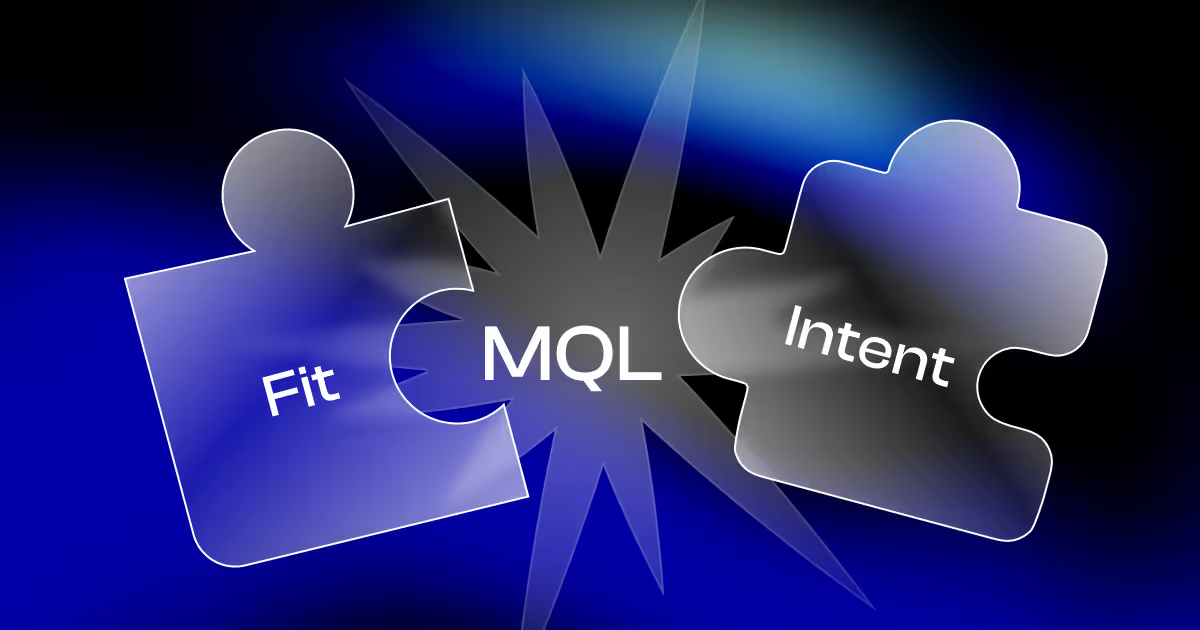
One of the first things you should do is align marketing and sales on what a “good lead” means. To do that, create a set of rules and agree on them. Figure out who fits your ICP, what actions count as intent, and at what point should a lead be passed over to sales.
Using the same checklist helps marketing generate less “junk leads,” and empowers sales to follow up faster.
Note: Use this tip only if you want your MQL-to-SQL rate to go up.
Make Your Marketing Dollars Go Further
Guess what? Every marketing campaign costs money. So your goal should be revenue, not traffic.
We track MQLs per campaign, then track what those MQLs turn into:
- MQLs generated
- MQL > SQL
- MQL > customer
For example: we run a campaign around our Funnel Mapping Template (this article is part of the campaign). If the campaign produces 50 MQLs, 10 of which become customers, we’ll know that our efforts brought an ROI and we start doubling down.
On the other hand, if it produces pageviews but no MQLs, we either change the offer, the messaging, or the funnel we focus on as a whole.
MQL Criteria: How we Defined a Marketing Qualified Lead for Our Business (You Can Do it Too)
Every business is different. What counts as an MQL for us won't work for someone else. So make sure to define your own criteria.
Involve Sales to Set Your Standards
We found that the best way to define MQLs is to get marketing and sales agree together. Marketing knows best what actions leads usually take. Sales knows best what a ready-to-talk prospect looks like.
So organize a gathering between the two teams and decide what makes a lead qualified. What actions matter most? What information do you need before sales should call? Get specific about the traits and behaviors that signal someone is worth pursuing.
Common Criteria Our Clients Use
Most companies we worked with look at a combination of factors:
Behavioral triggers show engagement:
- Downloaded gated content like guides or reports
- Attended a webinar or event
- Requested a demo or trial
- Visited the website multiple times
- Clicked through email campaigns
- Spent time on key pages like pricing or case studies
Demographic and firmographic filters ensure good fit:
- Job title or role (decision-maker?)
- Company size (target market?)
- Industry (do you serve their sector?)
- Location (region you cover?)
- Budget indicators (can they afford you?)
Engagement level measures overall interest:
- Lead score threshold (point-based scoring)
- Frequency of interactions
- Recency of last activity
- Multiple touchpoints across channels
How Lead Scoring Works
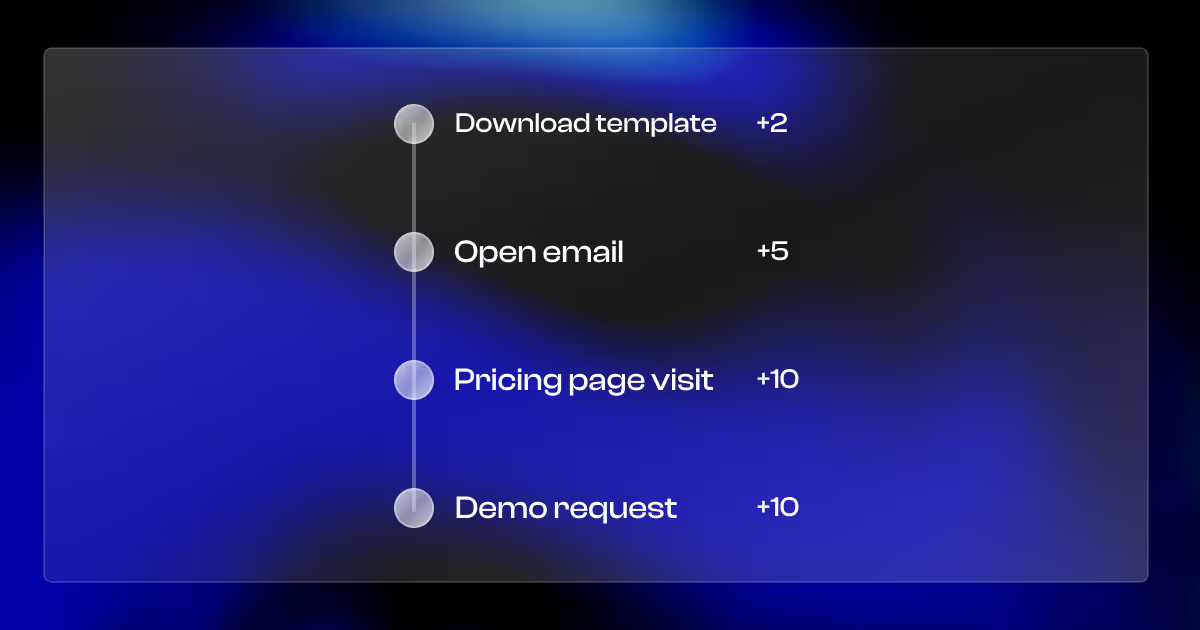
A good system we learned from one of our partner brands is lead scoring. It’s a system used to automate qualification and it works by assigning points for different actions and attributes.
Start by assigning higher points to actions closest to purchase intent. Demos and pricing page visits signal buying interest more than opening an email. Here's our example:
- Downloaded the template: 5 points
- Opened an email post download: 2 points
- Visited our pricing page: 10 points
- Joined our lead generation services sprint: 20 points
- Job title is executive (VP, founder, CMO, etc.): 15 points
- Company has 50-500 employees: 10 points
Once a lead reaches 30 points, they're an MQL. Your marketing automation platform of choice should be set to track this automatically and alert your sales team when someone hits the threshold.
Note: Initially the numbers will be far from perfect. Your goal should be to start benchmarking before perfecting your tracking.
Keep in mind, the assigned points to an action may be wrong. If you notice leads who visit your pricing page convert at twice the rate of template downloaders, increase the pricing page points accordingly.
Tailor the Definition to Your Business
Don't copy what other companies do. Think about what actually predicts a good customer for you.
A B2B startup selling to enterprises might define an MQL as someone with a C-suite title who requested a demo and works at a company with 1,000+ employees. On the other hand, a B2C company would likely focus on behavioral signals such as actively using a free trial for a week.
Actionable step: Analyze your past customers. What actions did they take before buying? What information did they share? Use the insights you gain to inform your MQL criteria.
Review Your Criteria Regularly (Businesses Change)
Markets change. Your product changes. Your ICP may change. What used to qualify as an ideal lead six months ago might not work anymore.
Make sure to occasionally review your MQL criteria with your sales team.
Actionable step: Ask: are the MQLs we're sending actually good? Are we missing people who should qualify? Are we sending over leads that aren't ready?
Adjust criteria based on your findings. If MQLs from a certain source never convert, raise the bar. If your sales team loves leads from a specific campaign, figure out what makes those people different and adjust your scoring.
What you can do When Your MQL Criteria Fail
You'll know your criteria are off when sales keeps rejecting your MQLs or when very few MQLs turn into customers. This is not great, but fixable.
First, look at the data. Which MQLs are converting and which aren't? Are certain lead sources consistently bad? Are specific job titles or company sizes converting better?
If too many low-quality leads are getting through, tighten your criteria. Raise the point threshold or add more qualifying questions to your forms.
If you're not generating enough MQLs at all, loosen the criteria slightly but track conversion rates closely. The goal is finding the sweet spot where you generate enough MQLs that actually convert.
How to Measure Marketing Qualified Leads
You can't improve what you don't measure. Tracking MQL metrics tells you if your qualification process works.
Count Your MQLs
Start with the volume: how many MQLs did you generate this month or quarter? The number helps you determine if your marketing efforts are attracting qualified prospects.
Track this over time to spot trends. Compare MQLs month over month, quarter over quarter, etc. Are you generating more MQLs than last quarter? Are certain months stronger? These questions help you understand what's working and if there’s seasonality to your business.
Track MQL Conversion Rates
The number of MQLs matters less than what happens to them. When it comes to conversions, there are two things you should track:
- MQLs-to-SQLs = SQLs / MQLs (how many MQLs the sales team accepts and pursues)
- MQLs-to-customers
MQLs-to-SQLs
If you generated 100 MQLs and sales accepted 50 as SQLs, that's a 50% conversion rate.
A low MQL-to-SQL rate means your qualification criteria might be off. You're sending leads that sales doesn't think are ready. A high rate means marketing and sales are aligned.
MQLs-to-customers
MQL-to-customer conversion rate shows how many MQLs buy. Divide customers by MQLs. If 10 of those 100 MQLs became paying customers, that's a 10% conversion rate.
This is your ultimate measure of MQL quality. If very few MQLs become customers, either your criteria are too loose or your nurturing and sales processes need work.
Track Cost Per MQL
Another important thing to track is your cost per MQL (CPMQL) to identify which channels and campaigns deliver qualified leads most efficiently. Calculate it by dividing your total marketing spend by the number of MQLs generated.
If you spend $5,000 on a webinar campaign that generates 50 MQLs, your CPMQL is $100. If a LinkedIn campaign costs $3,000 and generates 20 MQLs, that's $150 per MQL. Even if the webinar generates fewer total leads, it's more cost-efficient at producing MQLs.
That said, always pair CPMQL with MQL-to-customer conversion. If LinkedIn MQLs convert at 15% and webinar MQLs at 5%, the 'expensive' channel might be more profitable overall.
Compare CPMQL across channels, but always look at it alongside conversion rates. A cheap MQL that never converts isn't valuable. The best channels deliver both low CPMQL and high MQL-to-customer conversion.
Look at Lead Velocity
Lead velocity looks at how quickly do MQLs move through your funnel. If they're high quality, they should progress at a reasonable pace. If lots of MQLs stall and go nowhere, something's wrong.
Track the average time from MQL to SQL and from MQL to customer. If it's taking forever, maybe these leads aren't as qualified as you thought. Or maybe sales isn't following up quickly enough.
Use Your CRM and Analytics Tools
You need tools to track all this. Most CRMs like HubSpot, Salesforce, or Pipedrive can tag leads as MQLs and track their journey. If your site is hosted on Webflow, our Webflow HubSpot integration guide may be helpful.
Set up your system to automatically count MQLs and measure conversion rates. Even a spreadsheet works if you're just starting. The important thing is to actually look at the numbers regularly.
Adjust Your Strategy Based on What You Learn
Use the metrics to improve your marketing efforts.
If your MQL-to-SQL conversion is low, sit down with sales and tighten your criteria. If you're not generating enough MQLs, you need more traffic or better lead magnets. If MQLs convert well but slowly, look at your nurturing sequences.
Treat your MQL metrics as feedback that tells you what to fix and what to double down on.
MQL vs SQL: What's the Difference?
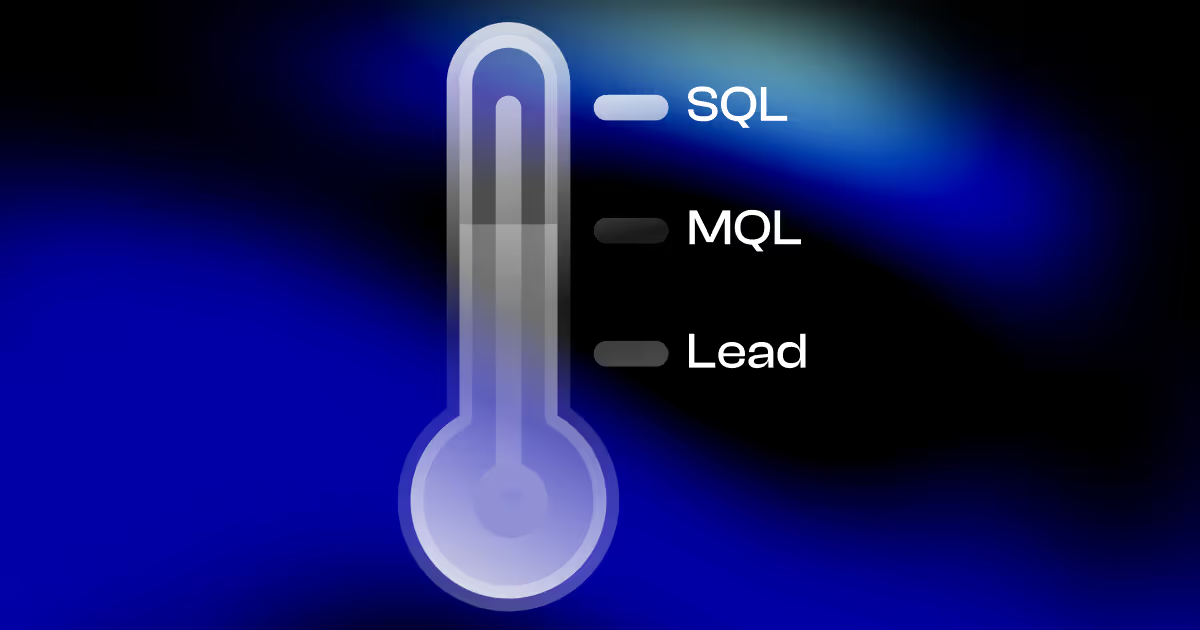
People often confuse MQLs and SQLs. Both are qualified leads, but they're qualified by different teams at different stages.
What Is an SQL?
A Sales Qualified Lead (SQL) is a lead vetted by the sales team and considered very likely to become a customer. They're ready for direct sales conversations about pricing, contracts, and closing deals.
SQLs have usually had some personal interaction with sales. Maybe a rep called them, sent emails back and forth, or had a discovery call. Sales has confirmed this person is a real prospect worth pursuing.
How MQLs Become SQLs
Here's the typical flow: marketing generates a lead and nurtures them until they meet MQL criteria. Marketing passes the lead to sales.
Sales reaches out to the MQL. They might call them, email them, or connect on LinkedIn. During this initial contact, sales asks qualifying questions: What's your timeline? What's your budget? What problem are you solving? Who else is involved?
If the answers check out, sales marks the lead as an SQL and continues working the opportunity. If not, they might send the lead back to marketing for more nurturing, or disqualify them entirely.
Different Teams, Same Goal
Think of it like a relay race. Marketing carries the baton (the lead) through the awareness and interest stages. When the lead hits MQL status, marketing hands the baton to sales. Sales evaluates whether they can carry that baton to the finish line (a closed deal).
MQL means "marketing thinks this person is ready for a sales conversation." SQL means "sales agrees and is actively working to close them."
Both labels help teams work efficiently. Marketing can be measured on MQL generation. Sales can focus on SQLs. When everyone uses the same definitions, there's less confusion and better collaboration.
Why Both Matter
You need both teams working together. Without MQLs, sales would cold-call everyone or sort through unqualified leads themselves. Without SQLs, you'd have no way to tell if marketing's MQLs are actually good.
The MQL to SQL handoff works well, marketing sends qualified prospects and sales converts them efficiently. In other words, your bottom line has improved.
How to Get More Marketing Qualified Leads
Before building new marketing tactics, validate your criteria. Once that's solid, focus on generating quality leads through strategic content and testing.
Start Conservative with Your Criteria
When you're first defining MQLs, best make mistakes on the side of being too strict rather than too loose. It's better to send sales 20 high-quality MQLs than 100 mediocre ones.
Set your initial point threshold high or require multiple qualifying actions before someone becomes an MQL. Track your MQL-to-SQL conversion rate closely.
Benchmarks vary widely by industry and sales cycle, but if you're seeing extreme numbers in either direction, something's likely off. The better approach: look at your own historical data to establish what "good" looks like for your business.
Gradually adjust your criteria based on what converts. If leads who attend webinars convert at 40% but leads who only download ebooks convert at 10%, you might decide webinar attendance is required for MQL status while ebook downloads just add points.
Create Content for Each Funnel Stage
People need different content at different stages. At the top of the funnel, they're looking for answers to basic questions. In the middle, they want deeper information to evaluate options.
Create blog posts and guides that answer common questions in your industry. This brings people in through search and social. Then offer more substantial content like ebooks, webinars, or case studies that require an email address to access.
When someone downloads that deeper content, they're showing real interest. That's how they move from casual visitor to a lead you can nurture into an MQL.
Audit Your Content Library
Before creating new content, check for gaps in what you already have. Map your existing content to each funnel stage: awareness (blog posts, social content), consideration (ebooks, webinars, case studies), and decision (demos, consultations, free trials).
If you have lots of awareness-stage blog posts like we used to, but no consideration-stage content such as case studies or product comparisons, you'll attract traffic but won't convert it to MQLs. Identify these gaps before investing in new content creation. You'll get better ROI filling holes than creating redundant resources.
Test Your Lead Magnets
Not all lead magnets attract the same quality of leads. A generic ebook like "10 Marketing Tips" might generate lots of downloads but few MQLs. A specific resource like "Enterprise Security Compliance Checklist" attracts fewer people but they're more likely to be qualified.
Run small tests with different lead magnets. Create a naming convention (like "LM_SecurityChecklist_Jan2026") and tag each lead magnet in your CRM so you can later track not just download numbers but how many become MQLs and ultimately customers. Double down on the magnets that attract high-quality leads, even if they generate less volume.
Use Progressive Profiling in Forms
Don't ask for everything upfront. Start with just email and company name. As leads engage more, ask for additional qualifying information like job title, company size, or timeline.
This keeps friction low while you gather the data you need. By the time someone has engaged multiple times, you have a complete picture of whether they're an MQL.
Set Up Lead Scoring and Nurturing
When a new lead comes in, don't immediately hand them to sales. Most leads need time and information before they're ready for a sales conversation.
Set up an email nurturing sequence that provides value over time. Start with a welcome email that delivers what they signed up for. Follow up with helpful content like relevant blog posts, case studies, or webinar invitations.
As leads engage with these emails, clicking links and visiting your site, they accumulate points in your lead scoring system. Track which pages they visit and which emails they open. When they hit your MQL threshold, sales gets notified.
This keeps you top of mind while helping leads educate themselves. By the time they become MQLs, they already know a lot about you and are much warmer.
Focus on High-Intent Channels
Not all traffic sources are equal. People who find you organically through search are often looking for solutions to specific problems. People who attend industry webinars are engaged with the topic. LinkedIn connections in your target industries are more likely to be qualified.
Figure out where your best customers originally found you. Look at which channels generate the most MQLs and which MQLs convert best. Then invest more in those channels.
If organic search brings in great MQLs but Facebook ads bring in tire-kickers, shift your budget accordingly. Go where the qualified prospects are.
Frequently Asked Questions about Marketing Qualified Leads
What's the difference between a marketing qualified lead and a sales qualified lead?
An MQL is qualified by marketing based on engagement. An SQL is qualified by sales after real contact. Think: MQL = interested. SQL = good lead confirmed by sales team.
Can a marketing qualified lead become a customer directly?
It happens often, but not in most B2B funnels. In high-ticket contracts, MQLs need follow-up and nurturing. MQL is a strong signal, not a guarantee.
What is an example of a marketing qualified lead?
A visitor reads this article, downloads the Funnel Mapping Template, and then clicks through a few nurture emails. If they later read a case study about how we helped a brand with our lead generation services and revisit our SEO lead generation services offer, that’s a clear MQL signal: repeated intent + problem awareness.
Should I pass all MQLs to sales immediately?
Not always. If sales reject a lot of MQLs, tighten criteria or add a quick “marketing accepted” check before handoff.
What’s a good SLA for MQL follow-up?
Keep it simple: marketing passes MQLs daily, sales responds within 24 hours, or the lead goes back to nurture.
How long does it take for a lead to become an MQL?
We face long consideration periods in our niche (B2B). It might take weeks or months. In the worst case, we converted a lead to a client in a bit over a year. Track this metric for your business to understand your typical timeline and identify leads that are moving unusually fast or slow.